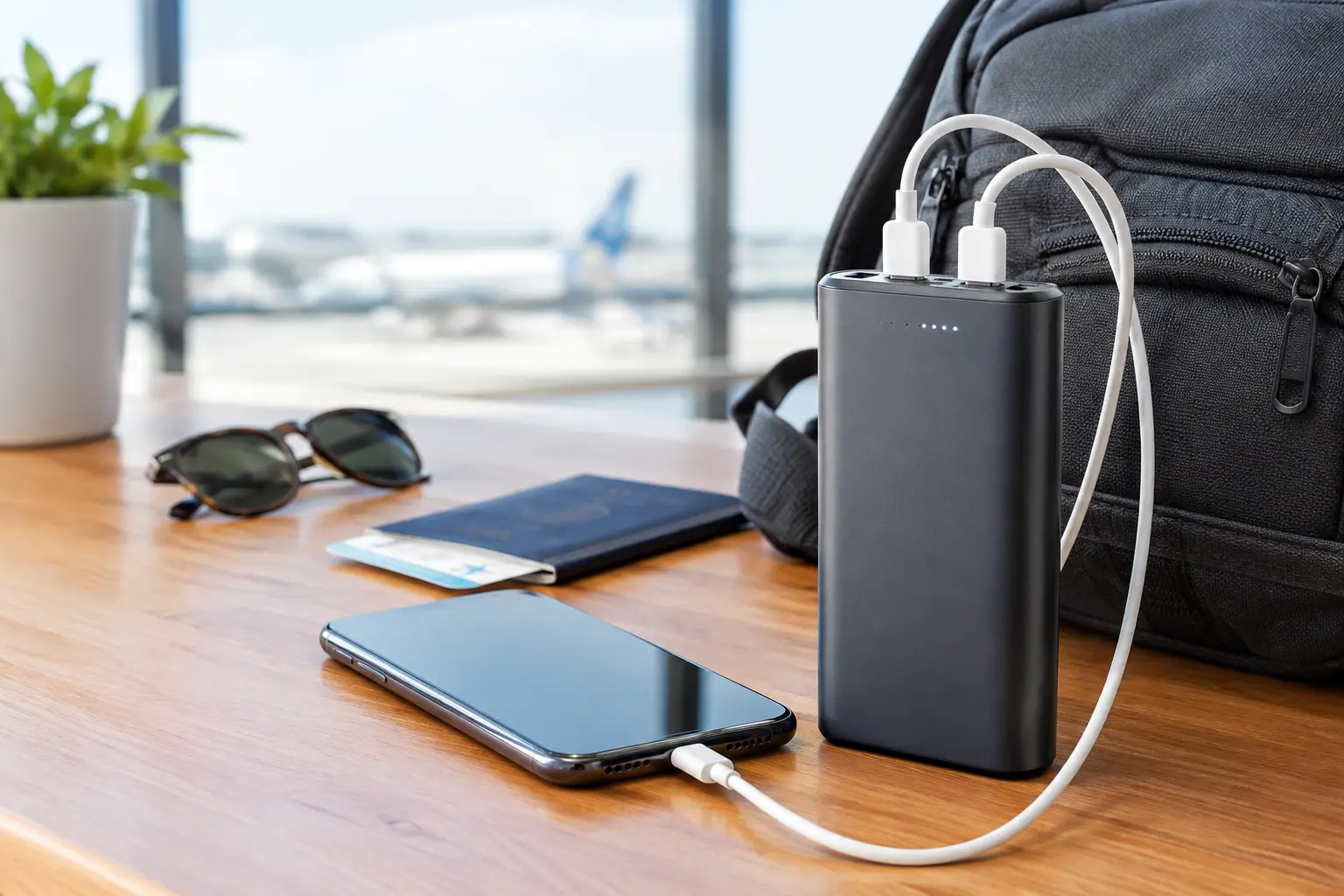
A dead phone is more than an inconvenience when you are standing in an unfamiliar airport, pulling up a boarding pass, booking a ride, or translating a menu. The right power bank for international travel keeps the essentials working without adding a heavy brick to your carry-on. For Canadian travellers, the best buy is usually not the biggest battery on the shelf. It is the model that meets airline rules, charges your devices quickly, and earns its space in your day bag.
What Makes a Great Power Bank for International Travel?
Start with capacity, measured in milliamp hours (mAh), but do not treat the largest number as an automatic win. A compact 10,000 mAh power bank is the easy choice for a weekend city break, a long travel day, or a backup for one phone. It usually fits in a jacket pocket or sling bag and can deliver roughly one to two full phone charges, depending on the phone and charging losses.
A 20,000 mAh model is the sweet spot for many international trips. It gives a phone several charges and can also handle earbuds, a smartwatch, an e-reader, or a second traveller’s phone. The trade-off is size and weight. It is still carry-on friendly, but you will notice it in a small crossbody bag.
Higher-capacity models can be useful for photographers, digital creatives, campers, or families sharing devices. They are less convenient for casual sightseeing, and some are close to airline limits. Before paying extra for capacity you may never use, think about how often you will actually be away from a wall outlet. Hotels, cafés, trains, and airport lounges can all provide charging opportunities, though they should not be your only plan.
Check Watt-Hours, Not Just mAh
Airline battery rules are normally based on watt-hours (Wh), not mAh. Most airlines allow spare lithium-ion batteries under 100 Wh in carry-on baggage, while larger batteries may need airline approval. Power banks generally must travel in your cabin bag, not checked luggage, because airline staff need to be able to respond quickly if a battery overheats.
Many 20,000 mAh power banks sit safely below 100 Wh, but check the product label before you buy and before you fly. The watt-hour rating should be printed on the unit. If it is not clear, skip it. A visible rating makes airport questions much easier and gives you confidence that the battery is suitable for travel.
Airline rules can vary by carrier and route, especially for larger batteries, so confirm the policy with your airline before departure. Also keep the power bank protected from loose keys, coins, and crushed cables in your bag.
Choose Charging Speed That Matches Your Devices
Capacity helps you last longer. Charging output determines whether a quick stop at the gate gives you a useful boost or barely moves the battery percentage.
For modern phones, look for USB-C Power Delivery, often shown as PD. A power bank with 20W USB-C PD is a strong value choice for many iPhones, Android phones, and compact tablets. It can charge compatible phones much faster than an older USB-A-only battery. If you own a newer Android phone, a laptop, or a tablet that supports higher charging speeds, compare the output requirements before upgrading. A 30W, 45W, or 65W power bank may be worthwhile, but only if your devices can use that power.
Do not forget input speed. A large battery that takes all night to recharge can be frustrating when you are packing for an early flight. USB-C input is now the practical standard. It lets you recharge the power bank with the same cable used for many phones, tablets, and laptops, cutting down on accessories.
A power bank with two or three ports is handy for couples and families. Still, read the total output rating. Some models reduce the available power when several devices are connected. That is normal, but it matters if you expect to fast-charge two phones at once.
Pack Fewer Cables and Adapters
International travel gets complicated fast when every device has its own cable. A USB-C-first setup is the simplest option for many travellers: one USB-C cable for your phone, one compact wall charger, and a USB-C power bank. If you use an older iPhone or accessory, add the right cable rather than relying on a bulky multi-head cable that may charge slowly.
A wall adapter and a power bank solve different problems. The adapter lets you use foreign outlets. The power bank lets you keep moving when there is no outlet, the outlet is occupied, or the hotel socket is placed behind a heavy nightstand. Bring both.
For international plugs, choose a dependable travel adapter that works in your destinations, but do not assume it converts voltage. Most phone, tablet, and power bank chargers are designed for 100-240V input, yet you should check the label on every charger. Hair tools and some older electronics are more likely to need a separate voltage solution.
The Best Capacity for Your Trip Style
There is no single best size for everyone. Match the battery to the way you travel instead of buying on a number alone.
A 10,000 mAh power bank is a smart, affordable pick for short trips, business travel, and travellers who only need phone insurance. It is light, easy to pack, and often available in popular colours and slim designs.
A 20,000 mAh model suits longer holidays, multi-city itineraries, road trips, and travellers carrying several small gadgets. It is also the better choice if your phone battery tends to fade after a long day of maps, photos, mobile data, and video calls home.
For laptops, compare the laptop’s charging needs with the power bank’s USB-C PD output. Many laptops need 45W or more for useful charging, and some will charge slowly or not at all with lower-output models. A high-output battery can be a great travel tool, but it costs more and adds real weight. It depends on whether you genuinely need to work away from outlets.
Features Worth Paying For
A built-in display is one of the most useful upgrades. Four tiny LED dots can give a rough idea of remaining charge, but a percentage display tells you whether you are leaving the hotel with 92% or 27%. That difference matters on a full transit day.
Pass-through charging can also be convenient, allowing the power bank to charge while it charges another device. It is useful at the hotel, though it can create more heat and is not essential for every shopper. Built-in cables reduce the chance of forgetting a cord, while removable cables are easier to replace if they wear out. Choose based on convenience versus long-term flexibility.
Safety features should never be treated as optional. Look for protection against overcharging, overheating, and short circuits, plus a brand with clear specifications and solid customer feedback. The cheapest no-name battery may look like a deal until it fails halfway through a trip or is rejected because its markings are unclear.
Quick Pre-Flight Power Bank Checklist
Before checkout, make sure your travel battery meets these practical needs:
- It is clearly labelled with its watt-hour rating and is allowed in cabin baggage.
- It has enough capacity for your itinerary without becoming annoying to carry.
- Its USB-C output supports the charging speed your phone, tablet, or laptop can accept.
- It uses cables you already own, or includes the right ones for your devices.
- It comes from a reputable brand and has the safety protections you expect.
At GadgetGuys, the best deals are the ones that still make sense after the flight home. Compare capacity, ports, charging speed, and included cables before choosing, rather than grabbing the lowest-priced option.
Use Your Power Bank Like a Travel Pro
Charge the battery fully before leaving home, then place it near the top of your carry-on for security screening and easy access. Do not bury it at the bottom of a checked suitcase. On the plane, avoid leaving it plugged in unattended or pressed under blankets and clothing where heat can build up.
You can stretch every charge by using offline maps, lowering screen brightness, downloading entertainment before the flight, and turning off data-hungry apps when you do not need them. A power bank is your backup, not a reason to run every battery-draining setting all day.
The best power bank for international travel is the one you will happily carry, understand how to use, and trust when your phone is at 4% in a new city. Pick the right capacity, pack the right cable, and you can spend more time enjoying the trip instead of hunting for an outlet.