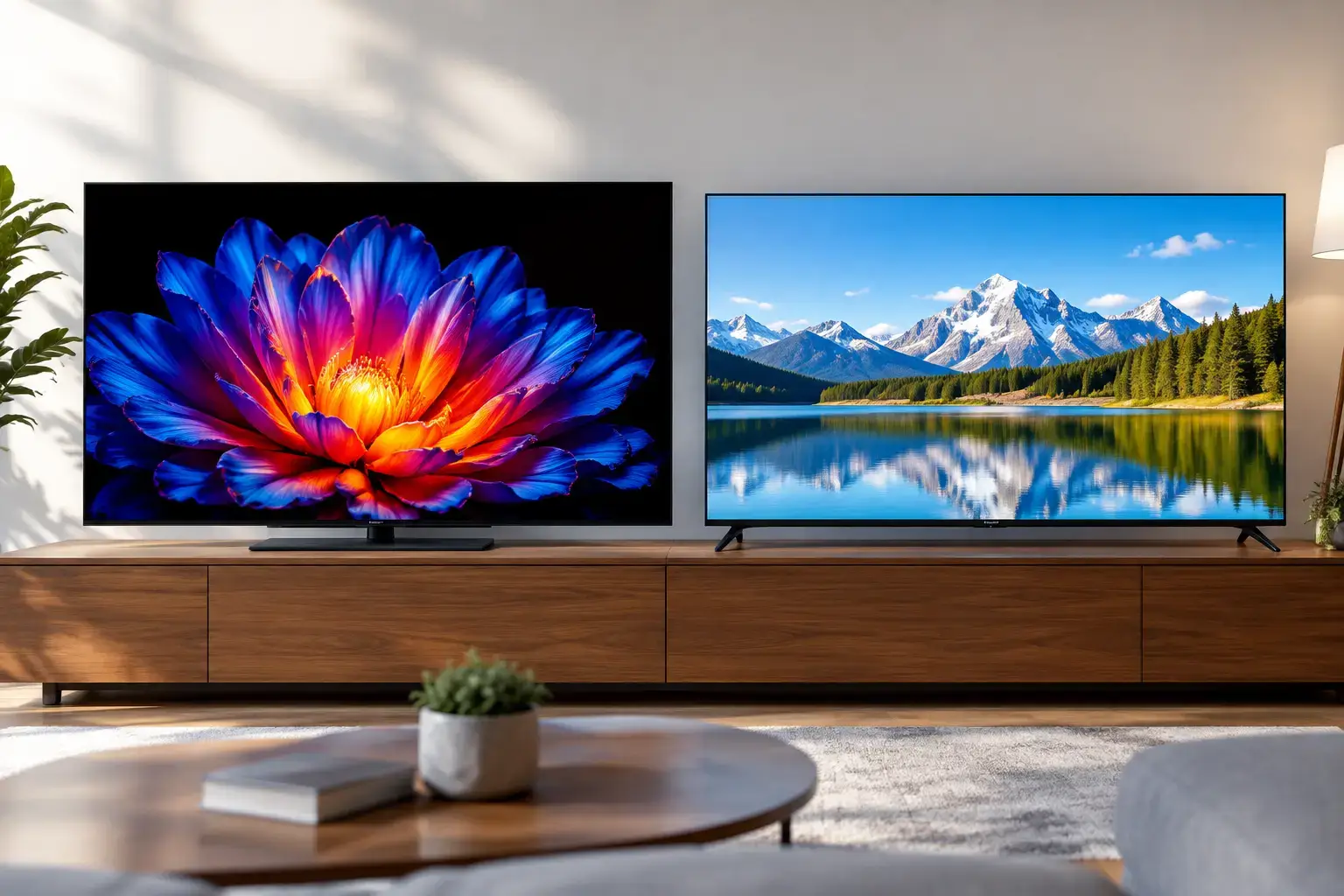
A bright living room at 2 p.m. and a basement movie night ask very different things from a TV. That is why an oled versus qled television comparison should start with your room, your viewing habits, and the deal in front of you – not just the label on the box. Both can look fantastic, but they earn their place in different homes.
For Canadian shoppers looking for a great screen without overthinking every spec, the short version is this: OLED usually wins for deep blacks, movie nights, and wide viewing angles. QLED often wins for daytime brightness, large-screen value, and family rooms with lots of natural light. The best buy is the one that fits how you actually watch.
OLED Versus QLED Television: The Core Difference
OLED stands for Organic Light-Emitting Diode. Each pixel creates its own light and can switch off completely. When a scene calls for black, an OLED screen can deliver true black rather than a dark grey. That gives movies, prestige dramas, and darker games a striking sense of depth.
QLED stands for Quantum Dot LED. Despite the similar name, a QLED television is an LCD TV with a backlight, plus a quantum-dot layer that improves colour and brightness. Premium QLED models may use full-array local dimming or Mini LED backlighting to control darker areas more precisely, but the backlight is still shared across sections of the screen.
This distinction matters most in challenging scenes. A space movie with bright stars against a black sky can look exceptionally clean on OLED. A QLED can still look excellent, especially a Mini LED model, but may show a little glow around bright objects against a dark background. On the other hand, QLED can push more brightness across the screen, which is a big advantage when sunlight is hitting the room.
Choose OLED for Movies, Gaming and Night Viewing
OLED is the easy pick when your television is used mainly after dark. Its pixel-level lighting creates superb contrast, so shadow detail appears more natural and black bars around widescreen films disappear into a dark room.
The viewing angle is another major benefit. If your family spreads across a sectional sofa, OLED keeps its colour and contrast looking consistent from the side. Many LCD-based TVs lose some punch when watched off-centre, although better QLED models have improved considerably.
Gamers also have plenty to like. OLED TVs often offer quick pixel response, low input lag, 4K at 120Hz support on selected models, and features such as variable refresh rate. Fast racing games, hockey, shooters, and colourful open-world titles can look wonderfully smooth. If you use a PlayStation 5, Xbox Series X, or gaming PC, check that the specific TV has the HDMI 2.1 ports and gaming features you need. The OLED badge alone does not guarantee every feature on every port.
There is a trade-off. OLED sets are often pricier than comparable QLED options, particularly at larger sizes. They may also be less comfortable in a very bright room if reflections are a daily problem. Modern OLED TVs are much brighter than older models, but a sun-filled space still tends to favour QLED.
There is also the subject of image retention. OLED technology can carry a small risk of permanent burn-in if a static image stays on screen for extremely long, repeated periods – think a news ticker, security camera feed, or the same game interface for hours every day. For normal mixed viewing, most people should not let this stop them from buying OLED. Built-in screen-care tools help, and modern panels are designed to manage static elements. Still, a household that leaves a channel logo or dashboard on all day may prefer QLED for extra peace of mind.
Choose QLED for Bright Rooms and Bigger Screens
QLED makes a lot of sense for the busiest room in the house. It can produce strong brightness, bold colour, and a picture that remains easier to see with blinds open and lights on. Sports fans will appreciate this during afternoon hockey, football, or baseball games, when gathering around the TV matters more than creating a cinema-dark space.
Value is often QLED’s biggest selling point. There are excellent options across entry-level, mid-range, and premium Mini LED ranges, and the savings can become significant at 65, 75, and 85 inches. If a larger screen will make the biggest difference to your household, a well-reviewed QLED may be the smarter purchase than a smaller OLED at the same budget.
QLED is also a practical choice for mixed use. Families who watch cartoons, stream daytime shows, pause games frequently, or use a TV as a casual display can enjoy the format without thinking much about static screen content. It is built around uncomplicated, all-day viewing.
Do not assume every QLED performs the same way, though. Basic models may have limited local dimming or no local dimming at all, which reduces their ability to create strong contrast in dark scenes. If evening movie viewing matters, look for full-array local dimming or Mini LED backlighting rather than choosing based on the QLED name alone.
Picture Quality Is More Than Black Levels
OLED’s perfect blacks give it a natural advantage in contrast, but brightness is only one part of the picture-quality equation. A great TV also needs accurate colour, good motion handling, effective upscaling, and reflection control.
For streaming, cable, and older consoles, upscaling matters because much of the content you watch is not native 4K. Better processors can make lower-resolution video appear cleaner and more detailed. For sports, look at motion settings and reviews of fast movement. A TV that looks brilliant in a showroom demo can still show blur or uneven backlight behaviour during a quick puck or ball movement.
High dynamic range, usually called HDR, is another area where both technologies can impress. OLED can make HDR scenes look dramatic because bright highlights sit beside truly dark pixels. QLED can deliver very bright highlights, which may create more impact in a bright room. If you mostly watch HDR movies in a dark space, OLED often has the edge. If you watch a lot of HDR during the day, QLED’s extra brightness can be more useful.
What to Check Before You Buy
Screen size, distance, and the specific model matter as much as panel technology. A 55-inch premium OLED may be ideal for a condo living room, while a 75-inch QLED could create the better shared experience in a family rec room. Measure the wall or TV stand first, including room for the feet if you are not mounting it.
Pay attention to these details while comparing deals:
- HDMI 2.1 ports, 120Hz support, variable refresh rate, and auto low-latency mode for current-generation gaming.
- Local dimming or Mini LED backlighting on QLED models if you watch films at night.
- Anti-reflection performance if windows or lamps face the screen.
- Smart TV platform, available apps, and whether the remote is simple enough for everyone in the home.
- Audio needs, because even a beautiful TV can benefit from a soundbar for clearer dialogue and bigger movie sound.
Also compare the full package, not only the television price. A sale can make room in the budget for a wall mount, HDMI cable, soundbar, or protection plan. For value-focused shoppers, that bundle can improve everyday use far more than a small step up in picture specifications.
The Better TV Depends on Your Home
Choose OLED if you want the most cinematic black levels, regularly watch movies in a dim room, sit at wide angles, or want responsive performance for gaming. It is the premium pick for viewers who notice subtle detail in shadows and want a picture that feels rich even without cranking the brightness.
Choose QLED if you need a bright, versatile screen for an active household, want the biggest possible display for your budget, or watch plenty of sports and daytime TV. A quality Mini LED QLED is especially compelling when you want strong brightness without giving up too much dark-room performance.
Before you shop, picture the television in use on an ordinary Tuesday, not in a showroom. The right screen is the one that makes movie night better, keeps the big game visible in daylight, and leaves enough in your budget for the rest of the gadgets you will actually enjoy.